
1999-P vs 1999-D Dime: Is There Any Real Difference in Value?
The Roosevelt dime of 1999 belongs to the modern clad era. The coin is not silver. and contains a copper core with a nickel outer layer. The design has remained unchanged since 1946.
Collectors often compare the 1999 P dime with its Denver counterpart. The question is simple: Does one have a real market advantage over the other?
So, here we invite you to explore production issues, strike quality, Full Bands, errors, grading levels, and current market behavior to compare this to coins and find out which one is finally the most valuable.
Basic Specifications: Same Metal, Same Design
Let’s start with the basics: both coins share identical technical standards when struck for circulation.
Feature | 1999-P | 1999-D |
Composition | Copper-nickel clad | Copper-nickel clad |
Weight | 2.27 g | 2.27 g |
Diameter | 17.91 mm | 17.91 mm |
Edge | Reeded | Reeded |
Designer | John R. Sinnock | John R. Sinnock |
There is no metal difference. No design difference. No diameter difference. Both carry the same Roosevelt portrait and reverse torch design. For circulation pieces, the coins are structurally identical.
Business Strike vs Proof Strike
The 1999 dime exists in three major forms:
Business Strike (P and D)
Produced for circulation
Matte or satin-like surfaces
Standard strike pressure
Found in rolls and daily transactions
Proof (1999-S)
Mirror-like fields
Sharper detail
Produced for collectors
Sold in official proof sets
Silver Proof (1999-S Silver)
90% silver composition
Higher issue price
Collected separately from clad coins
Proof coins are struck with greater care and show stronger detail and reflective surfaces. They are made for collectors, not for circulation. Silver proofs also contain intrinsic metal value, which adds a floor to their price.
As a result, proof and silver proof versions usually sell above face value, while standard P and D business strikes depend mainly on condition and grade.
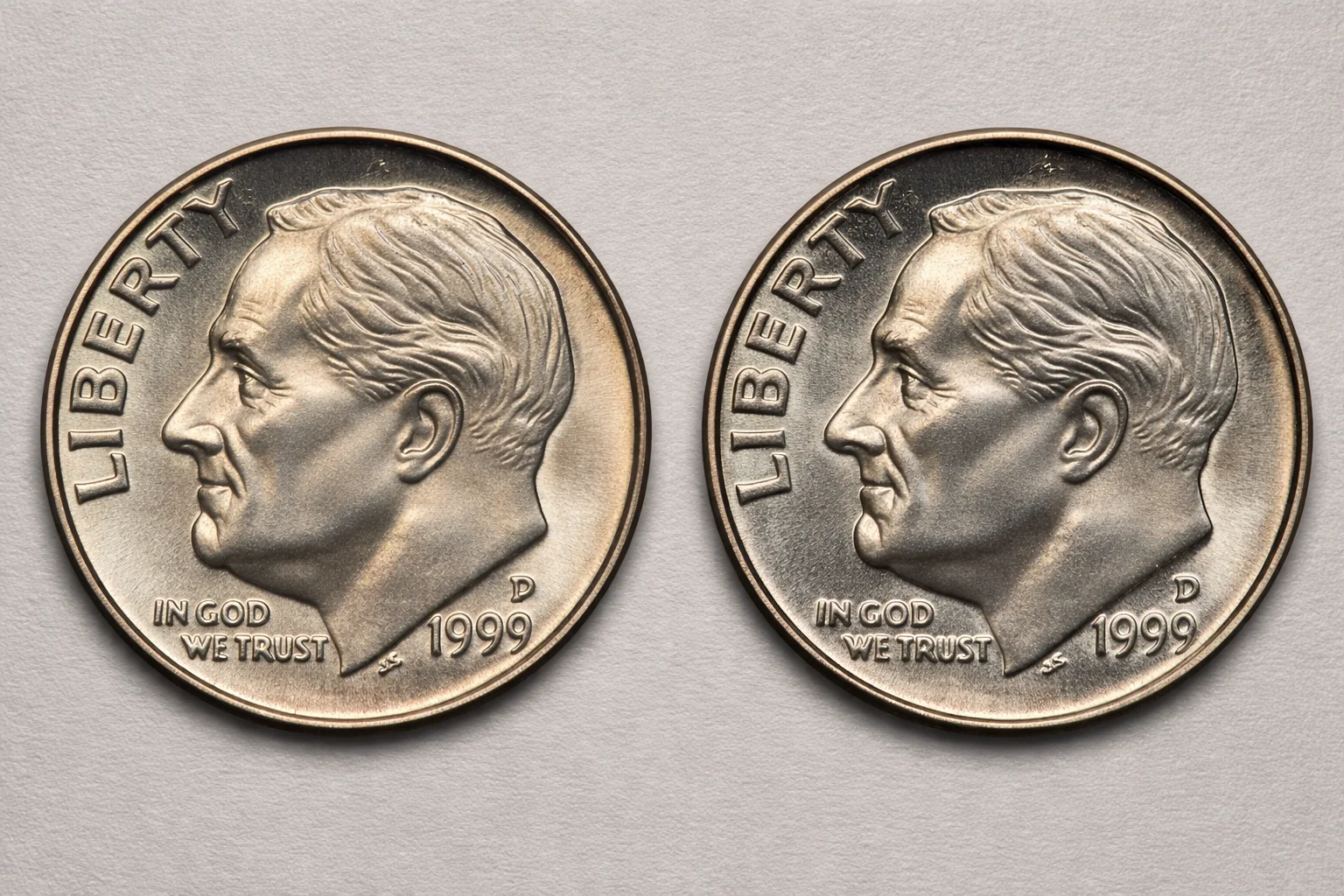
Mintage Comparison
Production numbers are high for both mints:
Mint | Mintage |
Philadelphia (P) | approx. 1.56 billion |
Denver (D) | approx. 1.39 billion |
The difference in mintage is not dramatic. Both were struck in large volumes. Neither mint produced a low-supply issue. Thus, availability in circulation remains strong for both.
Strike Quality: Are There Real Differences?
Mint location does not guarantee better strike quality. Differences appear on individual coins, not entire issues.
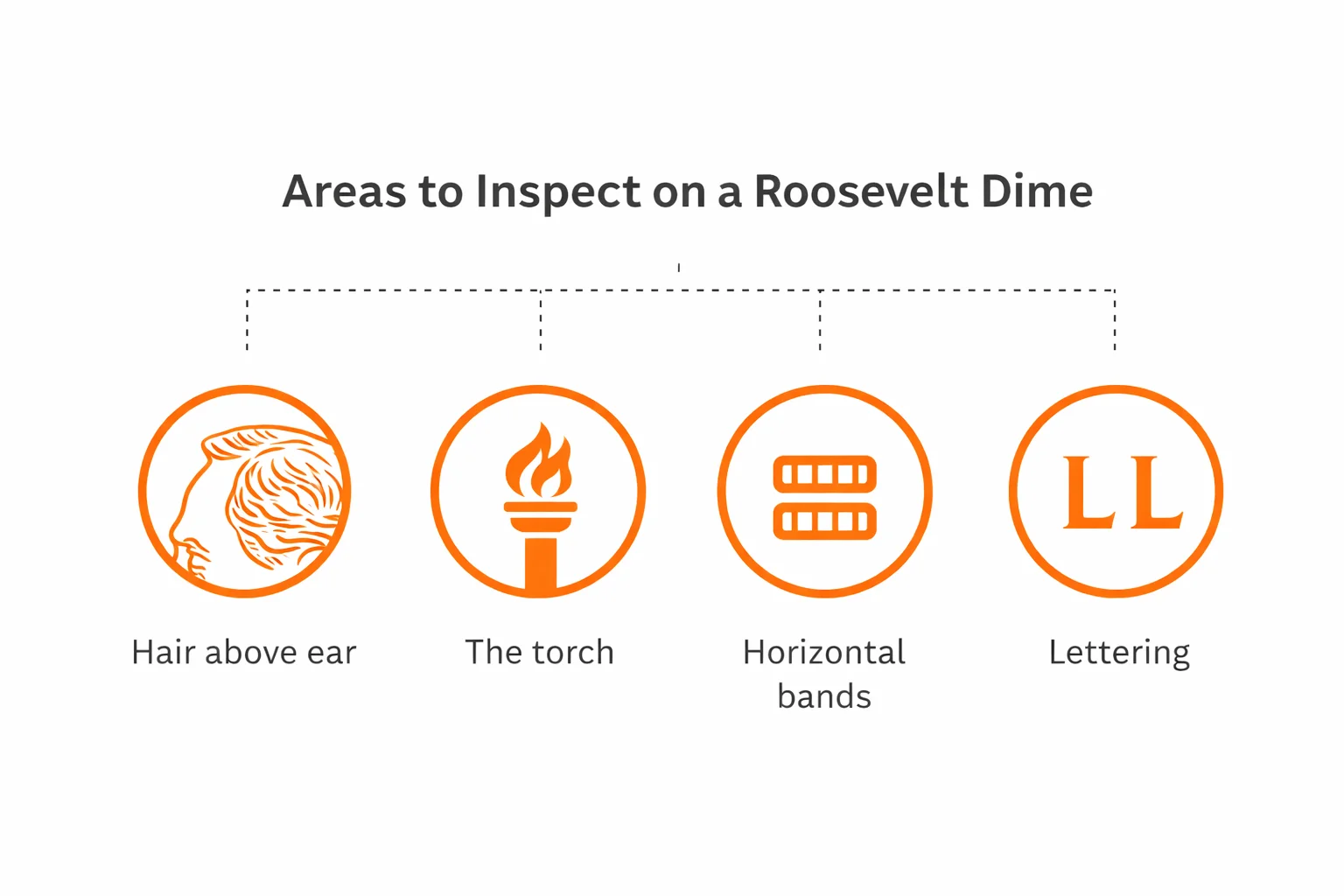
Areas to inspect:
Hair detail above Roosevelt’s ear
Definition of the torch
Separation of the horizontal torch bands
Sharpness of lettering
Some collectors report slightly stronger strikes from Denver in certain years. Others see no consistent difference. Market data does not show a systematic premium tied only to the mint mark.
Condition matters more than mint origin at standard grade levels.
The Full Bands Factor
Full Bands (FB) status drives much of the premium in Roosevelt dimes.
The torch on the reverse has two horizontal bands. For a coin to qualify as Full Bands, those lines must be fully separated with no merging.
Partial separation does not count. Weak strikes lose FB designation.
Both 1999-P and 1999-D exist in FB form. The market treats FB examples from either mint as premium material.
Registry collectors compete for top-grade FB pieces. That competition creates price separation at higher levels.
The key point is simple: the FB label affects price more than the letter P or D.
High-Grade Market Levels
In circulated condition, both coins are worth face value. Wear removes detail and eliminates premium.
In Mint State, differences begin to appear.
Grade | 1999-P | 1999-D |
Circulated | $0.10 | $0.10 |
MS65 | $2–$5 | $2–$5 |
MS66 | $5–$15 | $5–$15 |
MS67 | $40–$90 | $40–$100 |
MS67 FB | $120–$250 | $130–$260 |
MS68 | Auction-based | Auction-based |
At MS65 and MS66, prices remain modest. Supply is sufficient.
At MS67, premiums increase. Coins at this level show strong luster and minimal marks.
MS67 FB shows a significant jump. Demand from registry collectors supports these levels.
MS68 examples are rare. Prices depend on auction activity rather than fixed retail values.
Across grades, the difference between P and D remains small. Individual coin quality determines final results.
Error Coins: Confirmed Differences
Both mints produced standard strikes. Confirmed errors exist for each.
1999-D Doubled Die Obverse (DDO)
This variety shows noticeable doubling on obverse elements. True doubled dies display clear separation, not flat mechanical doubling.
Collectors value this variety when it is clearly visible.
1999-P Off-Center Strike
Off-center examples occur when the blank shifts during striking. Value depends on the percentage of misalignment. Coins with 20–50% shift and a visible date attract attention.
Minor shifts carry a limited premium.
1999-P Broadstruck on Cent Planchet
This is a wrong planchet error. The dime was struck on a copper cent blank. Diameter and weight differ from standard specifications. Weight falls near 2.5 grams instead of 2.27 grams.
Such pieces require scale verification and professional authentication.
Error coins do not favor one mint consistently. Availability is limited and sporadic.
Circulation Reality
Most 1999-P and 1999-D dimes in daily change remain common. Wear reduces the grade quickly: high points flatten, luster fades.
Circulation examples rarely exceed face value unless a clear error appears.
Collectors searching rolls focus on:
Clean surfaces
Strong strike
Minimal contact marks
Potential Full Bands
Both mints appear regularly in roll searches.
How to Evaluate One Properly
Examination should follow a routine.
Check the mint mark.
Inspect torch bands under magnification.
Rotate under soft light to evaluate luster.
Check for contact marks on Roosevelt’s cheek.
Weigh the coin to confirm 2.27 grams.
Small differences in strike or preservation can shift grade classification.
For quick confirmation of year, mint mark, and base specifications, try the Coin ID Scanner app. Use it to match the coin to official parameters before detailed grading begins. It provides structured reference information.
Market Demand and Collector Behavior
Demand for Roosevelt dimes remains steady but not speculative.
Most collectors build date-and-mint sets. Others focus on Full Bands examples. Registry competition concentrates on top-grade coins.
Here is how the market typically separates interest:
Circulated coins: no difference between P and D
MS65–MS66: modest premiums, similar levels
MS67 and above: strong competition
FB coins: higher premiums regardless of mint
Mint sets from 1999 preserve many high-grade coins. That keeps the supply stable. True condition rarities still command attention.
The market does not reward one mint automatically. Buyers look at grade, eye appeal, and certification.
Finally, Is One Really Better?
From a technical standpoint, the two coins are equal.
Same metal composition
Same weight
Same design
Similar mintage levels
In circulation, there is no difference in value.
At high grades, premiums depend on strike sharpness and surface preservation, not the letter below the date.
Full Bands status creates a stronger separation than the mint mark.
Confirmed errors exist for both mints. They are not exclusive to one side.
The conclusion is direct. Neither the 1999-P nor the 1999-D dime holds an automatic advantage. The market rewards condition, precision, and confirmed varieties. For most collectors, both serve the same role in a Roosevelt set. Only exceptional examples create meaningful differences.